Acne Marks vs Acne Scars
What’s the Difference and How to Treat Them?
After acne heals, many people are left with spots or uneven skin. These are often confused as the same problem, but Acne Marks vs Acne Scars are different and require different treatments.
Understanding the difference helps you choose the right skincare and professional treatments to achieve clearer, smoother skin, Dr. Desai’s Skin, Hair & Laser Clinic.
What Are Acne Marks?
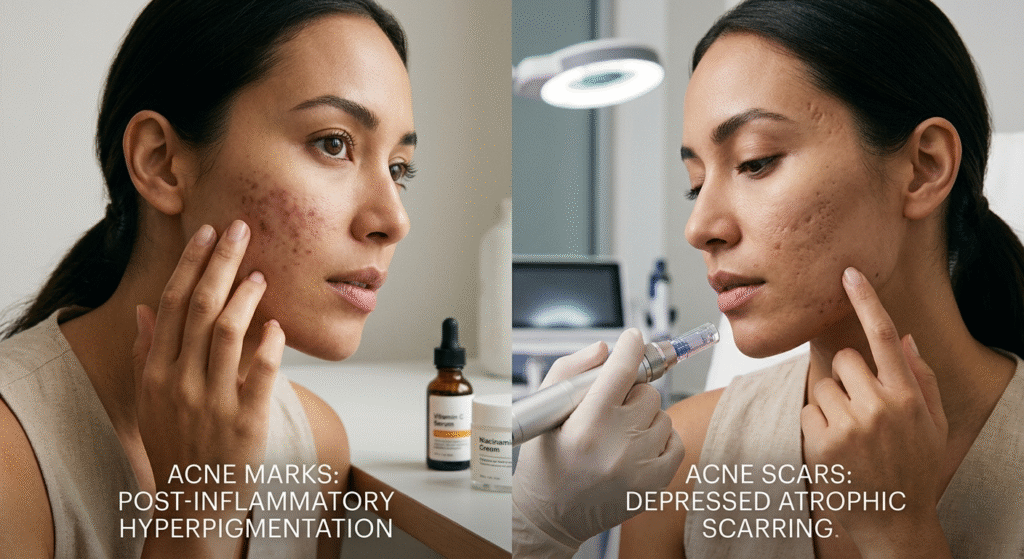
Acne marks are flat discolorations left behind after a pimple heals. They are not permanent and usually fade over time.
Types of Acne Marks
- Post-inflammatory hyperpigmentation (PIH): Dark brown or black spots
- Post-inflammatory erythema (PIE): Red or pink spots
These marks occur due to inflammation that triggers excess pigment production or affects blood vessels in the skin.
What Are Acne Scars?
Acne scars are permanent changes in skin texture caused by damage to the deeper layers of the skin.
Types of Acne Scars
- Atrophic scars: Depressed or sunken scars (ice pick, boxcar, rolling scars)
- Hypertrophic scars: Raised, thick scars
Scars form when the skin does not heal properly after severe or inflamed acne.
Acne Marks vs Acne Scars: Key Differences
| Feature | Acne Marks | Acne Scars |
|---|---|---|
| Appearance | Flat spots | Raised or depressed |
| Cause | Pigmentation or redness | Damage to skin structure |
| Texture | Smooth | Uneven |
| Permanence | Temporary | Long-lasting |
| Treatment | Skincare + mild treatments | Advanced dermatological procedures |
How to Treat Acne Marks
Acne marks usually respond well to skincare and mild treatments.
Topical Treatments
- Vitamin C
- Niacinamide
- Retinoids
- Azelaic acid
These help brighten skin and reduce pigmentation.
Chemical Peels
Peels exfoliate the skin and speed up the fading of dark spots.
Sunscreen
Daily sunscreen prevents marks from becoming darker and helps faster healing.
How to Treat Acne Scars
Acne scars require advanced treatments as they affect deeper skin layers.
Microneedling (MNRF)
Stimulates collagen production and improves skin texture.
Laser Treatments
Help resurface the skin and reduce the appearance of scars.
Subcision
A procedure used to release deep scars from underlying tissue.
Dermal Fillers
Used in certain cases to lift depressed scars.
How to Prevent Acne Marks and Scars
- Avoid picking or squeezing pimples
- Treat acne early
- Use sunscreen daily
- Follow a proper skincare routine
- Consult a dermatologist for persistent acne
Early care prevents long-term damage.
When Should You See a Dermatologist?
Consult a dermatologist if:
- Marks are not fading after several weeks
- You notice deep or pitted scars
- Acne is severe or recurring
- Over-the-counter products are not helping
Professional treatment gives faster and better results.
Acne Marks vs Acne Scars FAQs
Do acne marks turn into scars?
Not always. Marks are temporary, but severe acne can lead to scarring.
How long do acne marks take to fade?
They may fade within weeks to months with proper care.
Are acne scars permanent?
They are long-lasting but can be significantly improved with treatment.
Can home remedies remove acne scars?
No, scars usually require medical treatments.
Which is easier to treat: marks or scars?
Acne marks are easier and faster to treat than scars.
Conclusion of Acne Marks vs Acne Scars
Acne marks and acne scars may look similar, but they are different conditions that require different treatments. Marks are temporary discolorations, while scars involve deeper skin damage. With the right skincare routine and professional treatments, both can be effectively managed for clearer and smoother skin, Dr. Desai’s Skin, Hair & Laser Clinic.